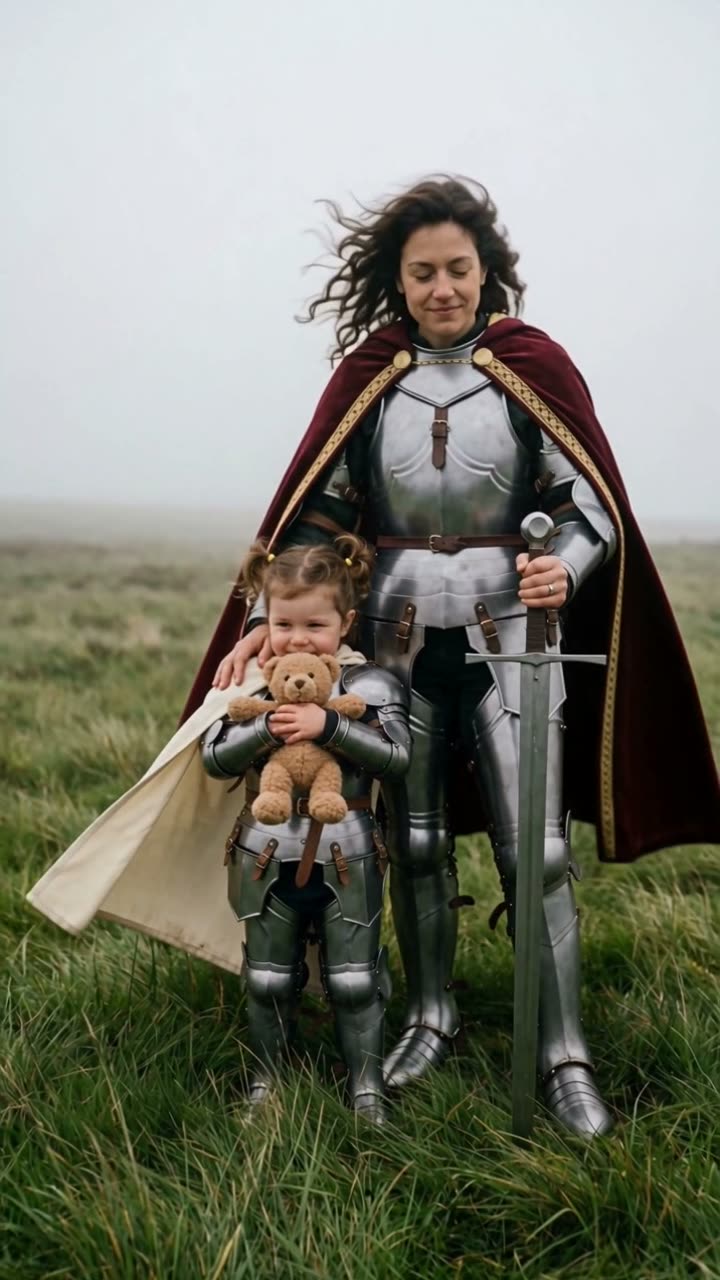
A slow, tender, cinematic scene from a real fantasy film, shot on 35mm with natural film grain and muted grey-green colors, on a wide misty moor of long, wet, green grass with thick fog hiding the horizon, overcast soft cool light and a strong wind from the left. One continuous shot with no cuts: the camera stays low at the child's eye level with a slight handheld sway, at a medium shot, so the faces stay large and clear until the end.
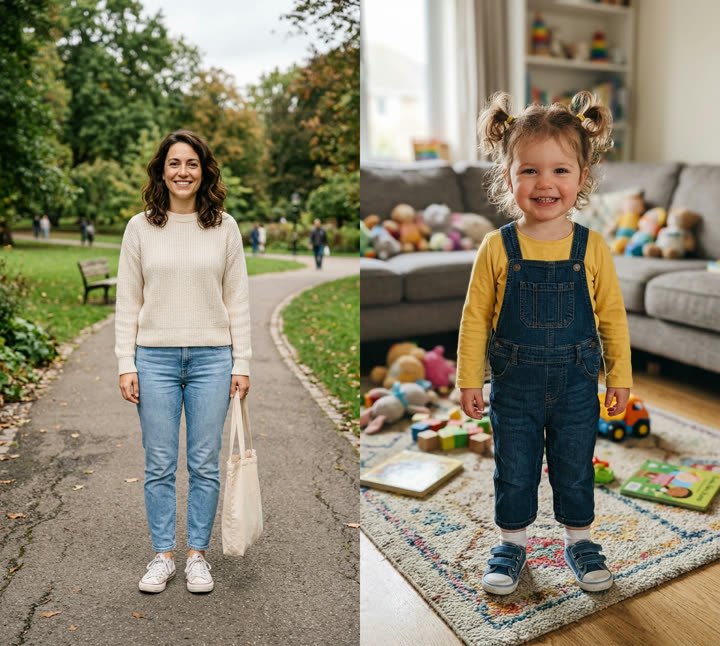
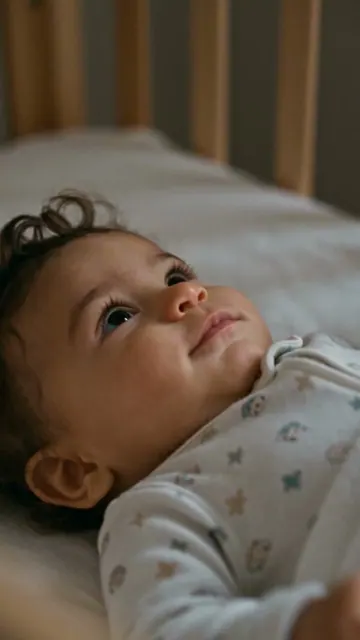
The parent is the adult in [Image 1], in every frame: copy the exact face from [Image 1] (the face shape, eye color and eye shape, eyebrows, nose, mouth, skin tone, age, hair color, hair length and hairstyle, and any beard, moustache, glasses or freckles).
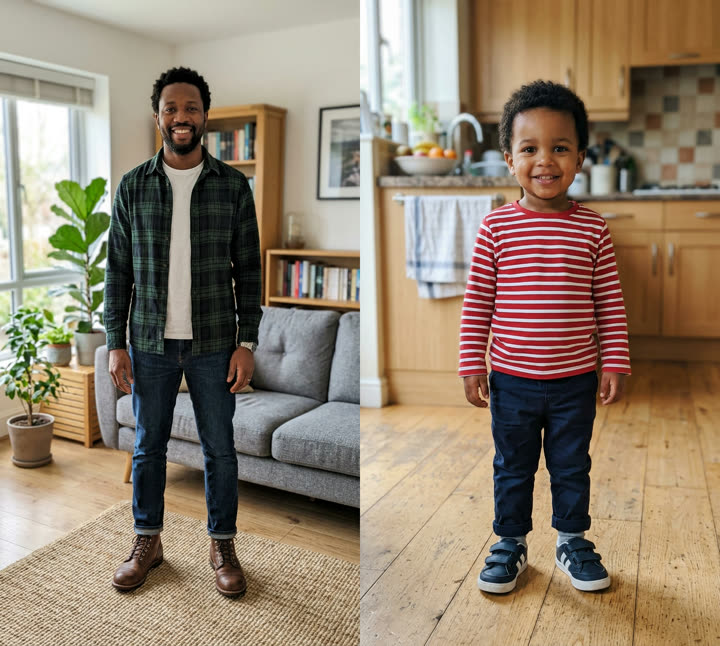
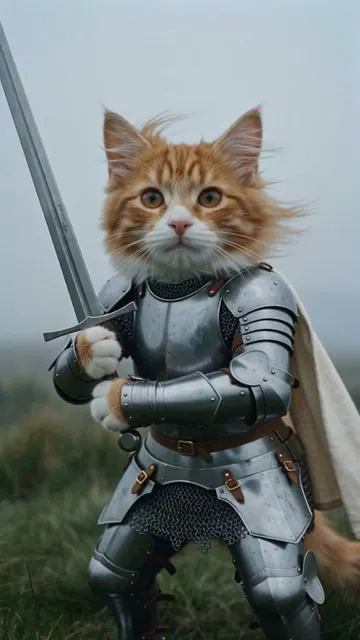
The little knight is the child in [Image 2], in every frame: copy the exact face from [Image 2] (the face shape, eye color and eye shape, eyebrows, nose, mouth, cheeks, skin tone, hair color, hair length and hairstyle) and keep the child's real age. Keep each child's gender from [Image 2]: a boy stays a boy and a girl stays a girl, with the same hair length as in [Image 2], also when the wind blows the hair; no long hair, bow or hair clip unless [Image 2] shows them. If [Image 2] shows a baby, keep the same baby at the same age, with the same face, eyes, nose, mouth, cheeks, skin tone and hair, standing upright as a tiny knight: never an older child. Leave out temporary marks on the skin, like scratches, bruises, stickers or food. If [Image 2] shows two children, both are little knights side by side, each with their own face from [Image 2] and their own sword, and the parent gives each of them a teddy bear.
The little knight is always the child and the parent is always the adult: if [Image 1] shows a child and [Image 2] shows an adult, the child from [Image 1] is the little knight and the adult from [Image 2] is the parent. Never put an adult's face on the little knight's small body.
Never blend the faces. Each face stays the same from the first frame to the last, so the family recognizes them at once.
The child wears small fitted medieval plate armor (a polished steel breastplate, rounded shoulder plates, jointed arm and leg plates, leather straps and small brass buckles) and a short cream cape, with no helmet. The parent wears polished steel plate armor with no helmet and a long dark red cape with gold trim, and holds a small soft brown teddy bear.
At the start the child stands in front and grips the hilt of a heavy steel longsword with both hands at chest height, point to the sky, just beside the face, so the hilt never hides the face; the blade rises far above the head. The child keeps the eyes open and frowns bravely against the wind with lips pressed together, struggling to hold the heavy sword upright while the wind blows their hair and cape. The child never cries and never screams. The parent, a few steps behind and to the right, walks slowly forward, kneels on one knee beside the child, gently takes the heavy sword from the child's hands and gives the child the teddy bear. The child hugs it tight with a small, relieved smile. The parent stands up, plants the sword point-down in the grass with one hand and rests the other hand on the child's shoulder, standing guard while the long red cape whips in the wind. Both look out into the mist, faces turned three-quarters to the camera.
Audio: howling wind, the cape flapping, soft clinks of armor, and an original slow, emotional orchestral score with sweeping strings and deep low notes, epic and tender. No dialogue, no lyrics. Wholesome and tender. No other people, no extra limbs, no morphing, no text, no logos.
3615 characters