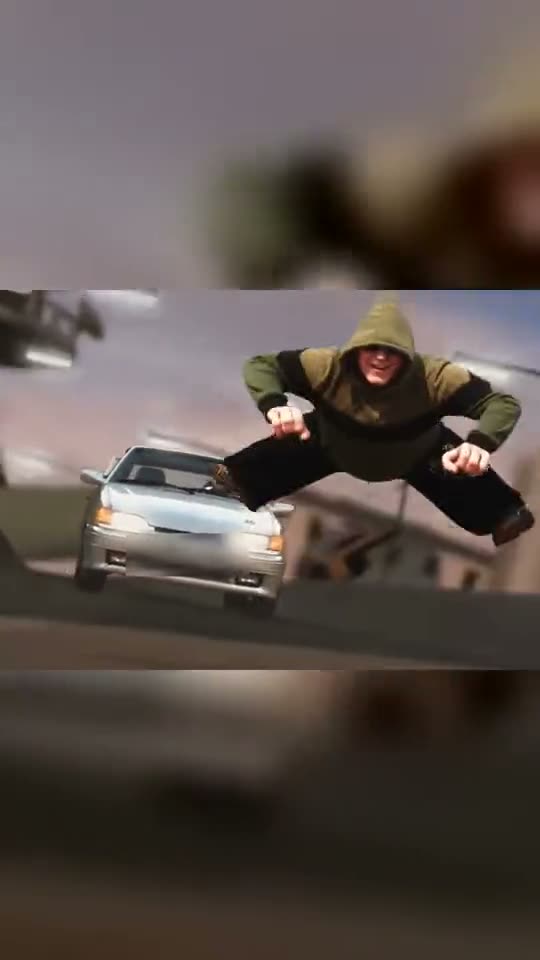
Use the reference video [Video 1] as the basis for the result, and the three uploaded images [Image 1], [Image 2] and [Image 3] as references for replacing objects.
[Image 1] is the first person to replace: the rider in the olive-green hoodie who rides an invisible motorbike down the futuristic highway, sitting in the air with the knees bent and the fists forward. [Image 2] is the second person to replace: the driver in red sunglasses at the wheel of the silver car that chases the rider. [Image 3] is the vehicle to replace: the silver car. The rider's motorbike stays invisible.
Analyze the original video yourself and identify the two main people and the main vehicle that must be replaced by the matching references. Do not ask the user for any extra description of the objects, and do not invent other objects to replace.
Completely replace the first and the second person with the people from [Image 1] and [Image 2] respectively. The replacement must be complete, including the head, face, hair, body, build, clothes and visible parts of the body, not only a face swap. Keep the natural anatomy and appearance of the people from the references.
Completely replace the vehicle with the vehicle from [Image 3]. [Image 3] is universal and may contain absolutely any kind of vehicle. Do not assume in advance that it is a car or any other specific type of vehicle. It can be a car, a motorcycle, a bicycle, a bus, a truck, a van, a train, a tram, an airplane, a helicopter, a boat, a motorboat, a yacht, a quad bike or any other vehicle. The type, look and features of the vehicle are defined only by [Image 3].
Keep the original direction of the video. The movements, poses, gestures, facial expressions, actions, trajectories, speed, the interaction between the people and the vehicle, the position of objects in the frame, the timing, the editing, the camera moves, the angles, the perspective and the composition must match the original video as closely as possible.
Do not change the plot, the order of events, the background or the surroundings unless it is necessary. Do not add new characters, objects or actions.
All replaced objects must move naturally and exactly repeat the matching movements of the original objects. Correctly account for perspective, scale, scene depth, overlaps between objects, foreground and background, contact with surfaces and the interaction between the replaced objects.
Keep the identity of the people from the references for the whole video. Do not allow changes of the face or appearance between frames, identity drift, flicker, random changes of clothes, changes of build, morphing or a gradual return to the original character.
For the vehicle, also keep a stable look for the whole video. Do not allow deformations, changes of its construction, random changes of the vehicle type, details or size.
Reproduce the lighting of the source video exactly. Keep natural shadows, reflections, highlights, contact shadows and the lighting on the people and the vehicle in line with the surrounding scene.
If after the replacement areas become visible that the original objects hid, use smart inpainting or fill them in only where it is needed for a natural result. This can include body parts, clothes, hair, the vehicle, shadows, reflections, the road surface or small areas of the surrounding background.
When filling in, do not change the existing scene more than needed. New elements must look as if they were really in the scene during filming.
Keep the source quality and visual character of the video: the natural sharpness, grain, compression, motion blur, depth of field and the traits of the source camera. Do not add artificial HDR, too much sharpening, a cinematic filter, a beauty filter or any other new visual style.
The main priority is the closest possible match to [Video 1], with a complete and realistic replacement of the two people and the vehicle by the objects from [Image 1], [Image 2] and [Image 3].
The result must not look like an AI generation on top of the original video, but like real footage in which the people from [Image 1] and [Image 2] and the vehicle from [Image 3] were there from the start.
The rider = the person in [Image 1], in EVERY shot, also when small in the wide shots: copy the exact face from [Image 1] - face shape, eye color and eye shape, eyebrows, nose, mouth, skin tone, age, hair color, hair length and hairstyle, and any beard, moustache, glasses or freckles exactly as in the photo. The rider wears the clothes from [Image 1]. NO sunglasses: no glasses of any kind on the rider unless [Image 1] shows glasses. No olive-green hoodie and no hood unless [Image 1] shows them. If [Image 1] shows an animal, the rider is that animal, sitting upright in the air with its front paws forward, with its own face, fur and markings and the natural body volume and proportions of that animal: never flattened, squashed, stretched or merged with anything.
The driver = the person in [Image 2], in EVERY shot where the driver shows: the close-up at the wheel and the small figure behind the windshield. Copy the exact face from [Image 2] - face shape, eye color and eye shape, eyebrows, nose, mouth, skin tone, age, hair color, hair length and hairstyle, and any beard, moustache, glasses or freckles exactly as in the photo. The driver wears the clothes from [Image 2]. NO red sunglasses: no glasses of any kind on the driver unless [Image 2] shows glasses, and no moustache unless [Image 2] shows one. No white-and-navy track jacket unless [Image 2] shows it.
The same real people in every frame, from the first shot to the last, so their friends instantly recognize them. Never morph, never drift back to the original people's faces, never add or remove facial hair. Both people change: neither person from the video stays anywhere, also in the wide shots and when only a small figure shows. Do not mix the two faces: [Image 1] is only the rider, [Image 2] is only the driver.
Shots, matching the reference:
1. 0 to 0.7 s: close-up of the driver ([Image 2]) at the wheel, both hands on the wheel, a cool stare.
2. 0.7 to 4.3 s: low shot on the highway at dusk: the rider ([Image 1]) sits in the air on the invisible motorbike, knees bent, fists forward as if on handlebars, grins and leans into the curve; the vehicle from [Image 3] chases right behind, with the driver ([Image 2]) behind the windshield; at the end the rider kicks off and flies with the legs spread.
3. 4.3 to 9.6 s: wide shots of the curving futuristic highway between giant pillars and towers: the small rider races ahead, the vehicle from [Image 3] follows and passes the camera.
4. 9.6 s to the end: medium shot: the rider rides straight at the camera on the invisible motorbike, fists forward, with a big grin - clearly the person from [Image 1].
Anatomy rules: one head per person, on that person's own shoulders. A face never appears on knees, legs, hands, clothes or the vehicle. The motorbike stays invisible: the rider sits on nothing. Exactly two people. No text, no logos, no readable license plate.
7090 characters